Trend intelligence
Signal
An intelligence terminal that predicts which ideas are about to go mainstream.
Built for · Brand, research and strategy teams
Demo with sample data
Impact
Teams act on a trend while it is still early, with the evidence and the confidence level in front of them.
- 3+
- signal sources in one timeline
- Bands
- confidence on every forecast
- Every
- prediction shows its sources
Before: Trends spotted after competitors move
After: Flagged while they are still micro-trends
Before: Gut-feel calls in strategy meetings
After: Forecasts with confidence bands and sources
Before: Analysts reading feeds by hand
After: Signals ingested and ranked continuously
Who feels itBrand and strategy teams move first, and can defend why.
What it does
How Signal works.
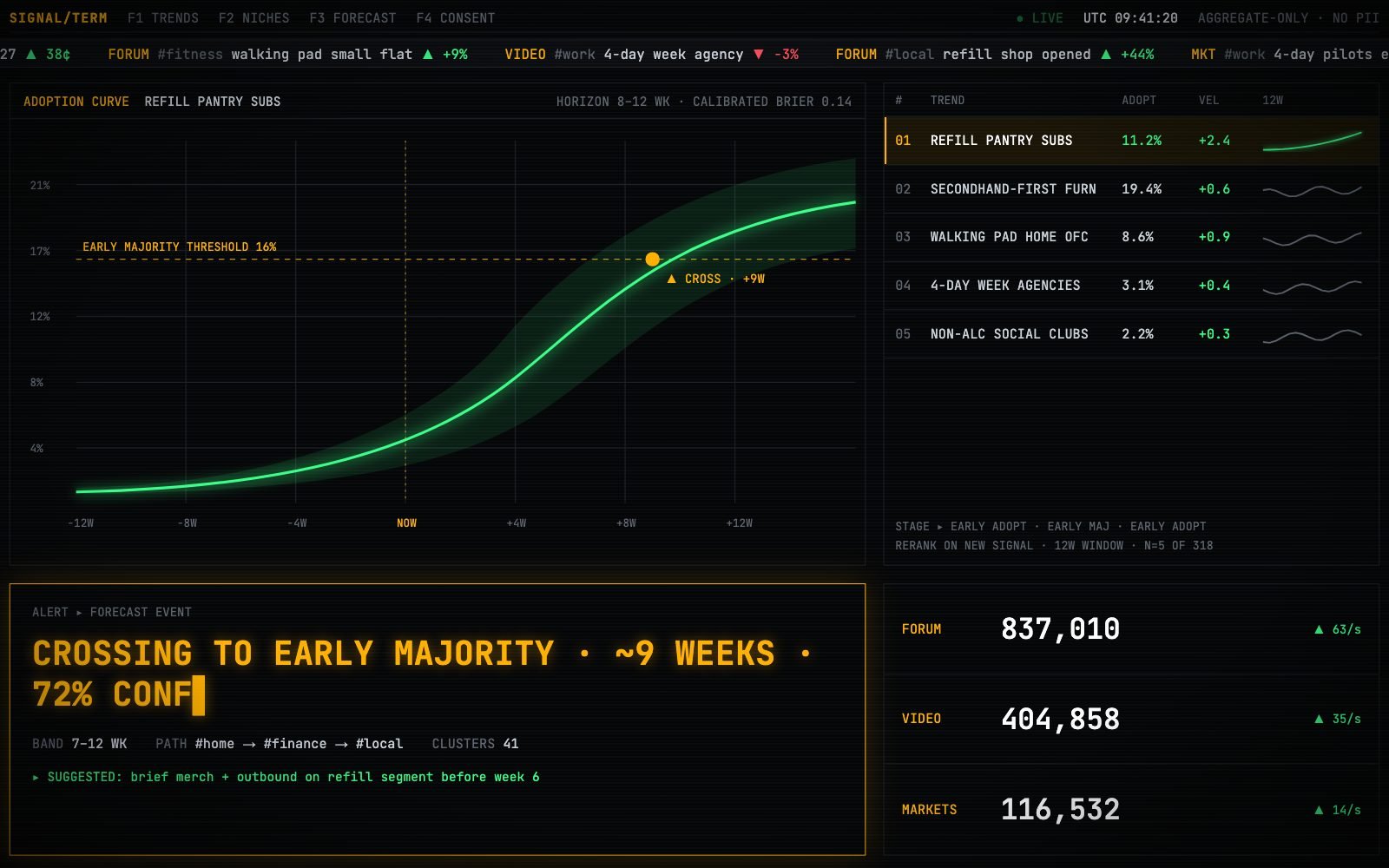
The system ingests public signals from Reddit, YouTube and prediction markets, and uses model-orchestrated reasoning to forecast which micro-trends will cross into the early majority, with confidence bands. Consent is built into the architecture, and it refuses queries aimed at manipulating individuals.
Many sources, one view
Discussion forums, video platforms and prediction markets are ingested continuously into one timeline.
Trends with confidence
Each emerging trend carries an adoption curve and a confidence band, not a single guess.
Explained forecasts
Every prediction shows the signals behind it, so analysts can argue with it.
Consent as architecture
Only consented data is used, and queries aimed at manipulating individuals are refused.
Screenshots
Inside Signal.
What it proves
Multi-source research agents that watch public signals continuously and turn them into calibrated, explainable forecasts behind a swappable model interface.
Where we apply it for clients
- Market and competitor intelligence
- Signal-based outbound
- Demand and trend forecasting
Built with
- Next.js
- Postgres
- Claude
- Data connectors
Want trend intelligence in your business?
Thirty minutes. One real workflow. We will tell you what it would take.